Sensual Architectures
- Peihang Benoit Solo Exhbiiton
Espace Temps invites you to the first-ever solo exhibition of Peihang Benoit in Paris, presenting a new body of work created over the past two years.
Espace temps Paris
98 Rue Quincampoix 75003 Paris
23 April- 19 June 2026
Vernissage: April 23rd, 2026 from 18h
Artiste | Peihang BENOIT
Curateur | Laurent Quénéhen
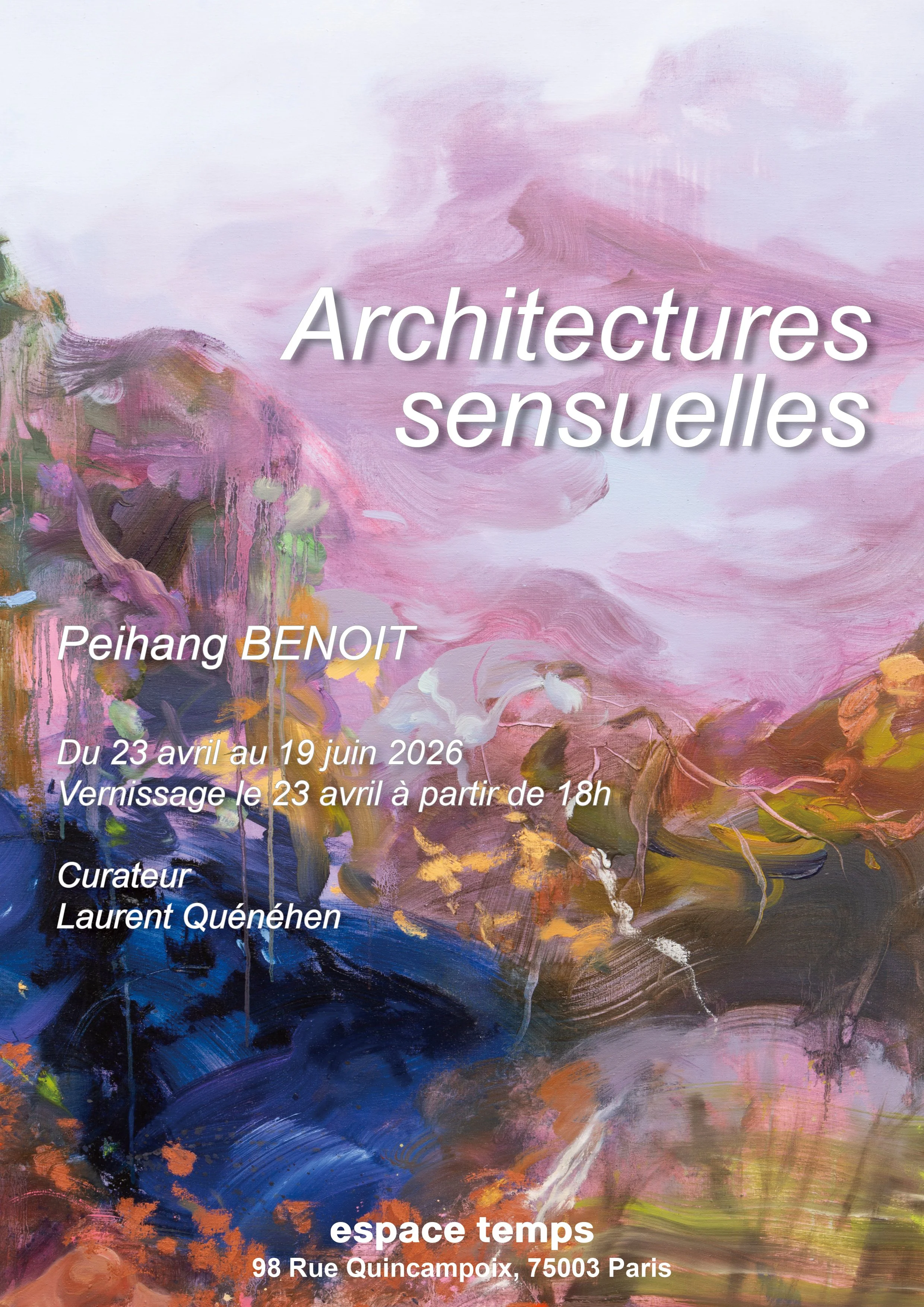
Sensual Architectures
Peihang Benoît is a Parisian painter born in Taiwan, who spent her childhood in the United States and studied in London. She is enriched by these diverse cultures, finding a distinct echo in her work.
Her methods and techniques reflect her personal history like “mille-feuille" (thousand layers) of influences and layers. Peihang Benoît begins by coating her canvases with an acrylic ground, a dominant tone, before constructing the architecture of her forms and curves with oil paint. She works on several canvases simultaneously, as their completion requires weeks or even months. Layers overlap, intersect, and intertwine in an energetic sweep that represents her vitality: an intimate, almost performative texturing. For her, painting is a way of (re)living her life: infusing the work with her energy and power, a unique and intimate Gestaltung (shaping). Body fragments appear and dissolve, remaining unstable, shifting, and transforming into suggestions of landscapes, water, or fire.
She paints with everything she is, her lived experiences, her multiple migrations, her uprootings, and her immersion into new cultures that deconstruct and reconstruct her perception of the world. This is partly what we find in her work: a maelstrom of influences and regenerations.
In some canvases, legs and feet appear, but she does not personalize them; she is not a figurative painter. Instead, she is interested in the trajectory
that inhabits them. She places flesh without identifying it, evoking and suggesting movements as if they were dancing. The whole is rhythmic and inspired, without falling into the easy seduction of illustration. Her works are sometimes rugged in their accessibility: one must approach them slowly, as one does with the Old Masters, to imagine landscapes, rivers, and universes in constant transformation.
The artist explores the lines of force in nature, not from an external gaze, but as an active participant. For her, man and woman are part of nature - even if they have become its somewhat maddening masters.
Peihang Benoît shapes her works with the memory of classical Chinese paintings she has encountered, structured through the interplay of void and solid forms and the circulation between lines. She associates these dominant traits with the history of Western painting. One finds the gestures of El Greco in her fiery and spiritual impulses, and allusions to Francis Bacon when she erases the identifying features of bodies.
What appears on the canvas—precisely what she seeks in her work—are apparitions and revelations, far more than premeditated creations. She allows the work to exist on its own; she offers herself to the painting, and the painting reciprocates.Moments overlap in different places; shapes recall rocks or round, pink hips like a child’s cheeks; yellow rivers irrigate mountains. We are most often in the metonymy of forms, the "correspondences" dear to Charles Baudelaire:
"Nature is a temple where living pillars
Sometimes allow confused words to emerge;
Man passes through forests of symbols
Which observe him with familiar glances.
Like long echoes that merge from afar
In a dark and profound unity..."
Every day, Peihang Benoît traverses and covers her works, augmenting, diluting, and listening to what the painting confides in her. It is an encounter with the nascent work: she gives and waits to see what emerges. It is a vital energy where the painter lets go to better find herself, discovering a form
of rapture in the practice itself. Some of her canvases are true fireworks.
Thus, on the four-panel screen Flaming Beasts ( Les bêtes flamboient , 2026), the world has turned upside down: we are in "seventh heaven." The blue is on the ground and young feet take flight toward the green grass; they possess a feline power. The small child is a spontaneous young animal, not yet disciplined. In this painting, we find the power of childhood at play, catching fire. This work evokes the brilliance of play and pleasure—a premise that transforms the fall into an elevation and discovers the sky upside down, as noted by Georges Bataille in Blue of Noon.
Other works possess a softer, less orgiastic sensuality, notably in the large painting Wind Song ( Le chant du vent ,2026), where fleshy beings, or perhaps mountains, seem to dominate, leaning over a magma of intertwining colors and forms. Lines of force are covered by lighter lines or, conversely, tagged like graffiti.
Peihang Benoît uses oil sticks and wide brushes that "blow" across the canvas. Here again, the plump legs of childhood dive into an ocean of colors that may evoke the future awaiting them. Other forms are on the edge of disappearance: the painter seems to seek the unrepresentable, the melodic, and sometimes the dissonant, beyond meaning. Abstraction dominates her works, where variations of red dance with ultramarine blues penetrated bybold greens.
There is a great sensuality in her canvases: one feels the heart of the color, the material, and the forms creating magnetic waves that pull the gaze inward.
Peihang Benoît views painting as a life experience. For her, it is not inanimate matter but a confrontation, or rather a relationship, both sensual and spiritual - that leads to a revelation of body and spirit, an ecstasy: a communication with the immensity of the living. This ecstasy can be reached in
different ways: through spiritual retreat, as monks do; at the heart of extreme suffering, like Christ on the cross; or, more desirably, through jouissance, as evoked by Georges Bataille in Madame Edwarda. These three paths lead to the same beatitude that so inspired Jack Kerouac, the founder of the Beat Generation.
Her painting has evolved over time: what previously appeared as distinct spaces, geographically and aesthetically bounded, has become unified, as if the painter had found her answers, her path to the sources of unity and the mysteries of creation.
What the painter attempts to apprehend in her work is a universe where every thing, every being, reveals its free and multiform soul. She is sensitive to these emanations, particularly those possessing vital energy: children at play, waterfalls, fire, wind—everything that makes the living world vibrate, including jouissance in the noble sense of the term, which is not told but felt, lived, and, evidently, painted.
Another particularity of her work is the distance of the gaze; her works provide "stationary travels," both situational and temporal. If one observes the painting Under The Same Sky ( Sous le même ciel ,2026) from a few meters away, four legs are distinguishable: two are blue, two others in variations of mauve. They cross the width of the work, encircled by a swirl of "Eros pink," with what looks like a wooded landscape at their center.Upon moving closer, the legs fade away to reveal a bucolic scene: characters, a table, perhaps a swimming pool, clearly a radiant memory that has contributed to an equally bright future.
In the smallest detail, the slightest patch of paint, the entirety of creation is found. This is what Peihang Benoît allows us to see: a sensual architecture with its lines of force, where one suspects that heaven and hell can exist on each slope of the same mountain. It remains only to choose the right side.
Laurent Quénéhen, Curator
Curator
Laurent Quénéhen, independent exhibition curator (member of C.E.A) and art critic for the magazine artpress (member of AICA), president of the associations Brigade des Images (short film programming) and les salaisons (exhibitions at the art space les salaisons in Romainville from 2007 to 2015 and itinerant since June 2015).
Espace temps
98 Rue Quincampoix 75003 Paris
Du mercredi au samedi 14h – 19h
www.espacetemps.art
espacetempsart@gmail.com